The Homeowners Guide to Navigating Post-Flood Recovery and Cleanup
In the aftermath, you often have a mixture of emotions from feeling fortunate it wasn’t worse to wondering what to do next. So, here’s the deal: regardless of how deep the water got, it pays to prepare for a dirty job that exposes you to things you wish you’d never laid eyes on. If this week’s events take homeowners in a flood’s path as history, you should prepare yourself for the experience.
Why "Dry to the Touch" Means Nothing
Thinking your flooded home is dry enough to rebuild is one of the scarier mistakes homeowners make, because it’s a double threat. First, there’s the deception that surface materials have dried to safety after a few fans and dehumidifiers ran for a week.
Then, there’s the false security that if something was missed, at least you have insurance. You do, but it probably won’t cover long-term, hidden rot you could have prevented. Insurers expect you to perform responsible maintenance in the wake of a flood. That includes doing or having done a thorough moisture check behind walls, below floors, and above ceilings.
Don’t put new wallboard over old studs that are moist or moldy. Don’t reinstall carpet on a foam pad that’s still waterlogged. Don’t rebuild until everything that got wet has been probed and tested. This is one of those singular moments in your home-owning life when partial won’t do. Do it right, or down the road, you’ll be doing it all again.
The First 24 Hours: Triage Before Cleanup
According to FEMA, it only takes one inch of floodwater to rack up as much as $25,000 in damage to a typical single-story home. That’s assuming fast response. If the water lingers, the problem grows exponentially.
The first step is to determine if the water is still coming in. A failed sump pump during a rainstorm is one thing. A river that’s jumped her banks is quite another. You can’t start drying until the water’s done rising.
Step two: Identify the water itself. Clean Category 1 water comes from a broken supply line, a tub that accidentally overflows, or an armful of saturated-but-pure garden soil. Category 2 water is contaminated, and you’d be prudent to assume Category 3, or black water), which contains sewage, chemicals, or dangerous pathogens, until testing and the passage of time prove otherwise. Protective gear and special disposal rules apply to black water, so don’t go wading without knowing what you’re stepping in.
Assuming you’ve got the okay on both of those, step inside, but not before you get everything on your phone camera. High-res pics of every room, every item, every watermark on the walls. This is how an insurance claim is made, before the first broken bit of drywall hits the ground.
When to Stop Doing it Yourself
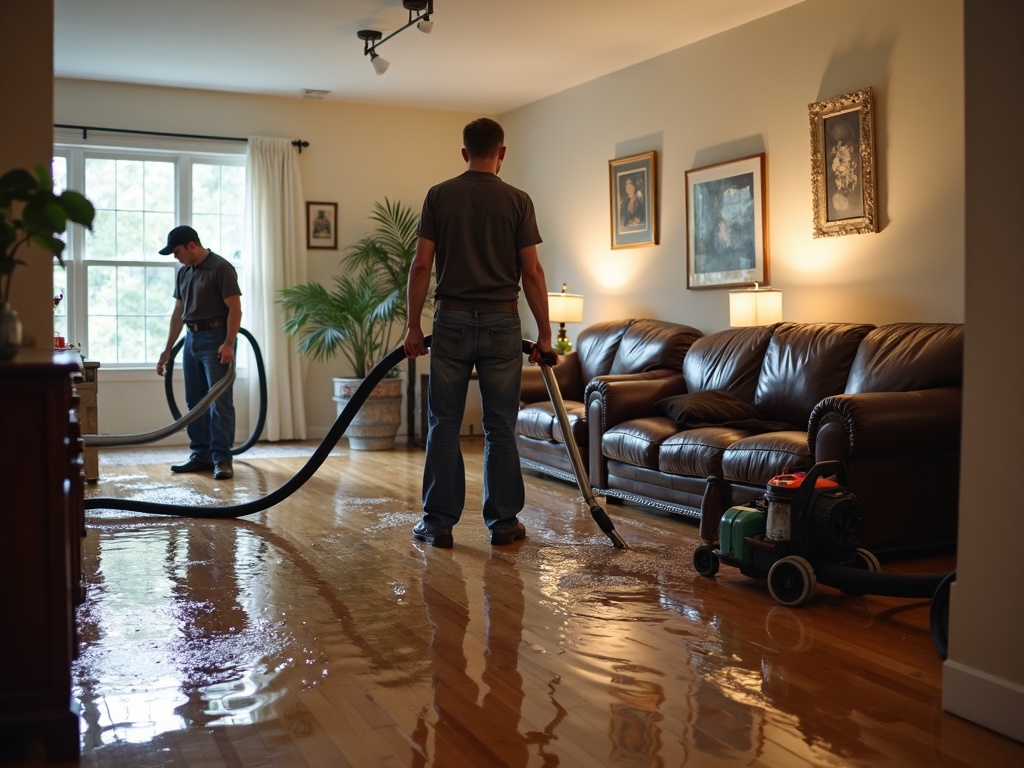
Household fans are inadequate in a flooding situation, where you need cubic feet per minute (CFM). Industrial air movers reach CFM levels capable of breaking the saturated boundary layer from the building material and releasing moisture into the air for dehumidifiers to capture. That’s the kind of gear you need, not a fan from your living room.
For Cat 1 (clean) water, if we’re talking about a small, well-ventilated space, some DIY extraction can help until the pros arrive, as long as it’s not seeping under walls into the next room. With Cat 2 (gray) and Cat 3 (black) water and/or water that gets to subflooring or inside the walls, the moisture is a structural problem now. The same goes if a day or two’s effort isn’t dropping moisture measurably and you’re still looking at weeks of dehumidifier running. The situation has outsized your gear’s capacity and that’s the point of greatest risk for future structural rot.
Industrial-grade pumps and extraction systems can only be provided by the pros. Premier Emergency Water Removal will pull the water right out of your deep building materials, making it much easier to dry down your home before secondary damage comes to light weeks down the road.
The Top-Down Drying Strategy
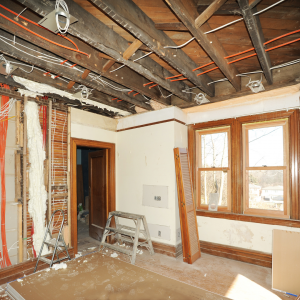
Once the extraction began, the removal is performed in a sequence. The saturated carpet padding is the first to go, as it contains an enormous amount of moisture and acts as a barrier preventing airflow to the subfloor. Then insulation from the affected walls is removed because wet insulation hardly dries and immediately turns into a breeding ground for mold.
Mold can start to develop within 24 to 48 hours after being exposed to water. So, removing wet materials promptly has nothing to do with how things look, it’s about allowing the structural studs to dry before fungi proliferate, or you will have to face a mold removal process on top of everything else.
After that, industrial dehumidifiers come into play with air movers to exploit the psychrometry’s principles and accelerate appropriate evaporation over building materials. The rate controls the process. The idea is to bring building materials to their drying goals, aka acceptable moisture content percentages predetermined by restoration standards, rather than merely drying the room.
Insurance Documentation and What Actually Matters
The way replacement cost coverage differs from actual cash value coverage determines how much you get reimbursed. Replacement cost coverage pays for current pricing to replace the damaged items. Conversely, the actual cash value coverage takes depreciation into account, for instance, a ten-year-old water heater is reimbursed at the price for a ten-year-old one.
Be clear on which type of coverage your policy offers before your discussions. Check your records while going through your inventory item by item. Claims adjusters base their decisions on what you can substantiate, not what you have in your memory.
Making assumptions is not going to help you recover from the flood. The homeowners who manage to keep their property after flooding are those who take quick action, document every detail, and come to terms with the fact that the most severe damage is often invisible.