A Room-by-Room Guide to Selecting the Right Interior Paint Finish
Many homeowners choose a paint finish per room for the moment. That’s wrong. The sheen you choose for your whole house must be defined by beginning with the highest abuse rooms and then moving to the next, as the durability required in one space affects how the next room reads and functions.
Understand the sheen spectrum before you touch a swatch
Every type of paint cover varies between being completely flat and highly reflective. This quality controls both the level of reflection – how well the wall bounces back light – and the level of scuff resistance. It’s always a direct tradeoff: the most “scrubbable” paints also show absolutely every flaw in the wall beneath them. A flat latex may look rich and velvety, but one stray ballpoint mark and it’s done for. For homes with rougher walls, more recent drywall work, or those who feel like they are done with semi-gloss, a flat or a matte likely strikes the right balance.
Start with the hardest-working rooms, not the prettiest ones
Here’s an alternative idea. We typically order the toughest paints without thinking much about it – then put them in the easiest places for paint to survive. What if, instead, you set your paint and finish choices by establishing which walls need to take the most damage and cleaning abuse, first? Most guides tell you to plan bedrooms first because they’re easy. We’d flip that. Start with entryways, hallways, laundry rooms, kids’ rooms, and any wall that gets touched, bumped, or scuffed daily. These spaces set your durability floor. Once you know what those walls need to survive, the rest of the home’s finish plan falls into place around it, rather than being decided in isolation room by room. Hallways and entries take backpacks, dog leads, and dragged furniture.
Bedrooms and formal spaces: where flat still earns its place
Bedrooms and formal dining rooms are also lower-traffic, and flat or matte finishes are suitable there. Walls are not touched as frequently, so you can mask imperfections without compromising durability.
Nonetheless, flat paint still requires maintenance, even in a low-traffic room. Wet marks from hitting a glass, scuffs from adjusting a headboard, or a child’s oily fingerprint as they head to bed will not come out of a flat wall simply by using a damp cloth. You’ll have to repaint over the smudge instead of cleaning it.
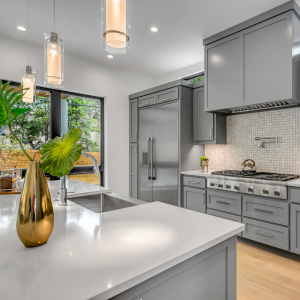
Kitchens and bathrooms need a completely different logic
This is where most home paint schemes quietly die. Kitchens deal with grease, steam, and constant splashing. Bathrooms deal with condensation and standing humidity, and in a place like Perth, where coastal air and winter damp both push moisture indoors, that humidity risk is real. A flat wall finish in either of these rooms isn’t a style choice – it’s a functional mistake. Flat paint has more open texture at a microscopic level, which gives mould more surface to grab onto, and it can’t be wiped down after every shower or cooking session without smearing.
Satin or eggshell on the walls, paired with semi-gloss on the trim, is the standard combination for wet rooms. It gives you a surface that resists moisture and wipes clean without looking like a hospital corridor. If you’ve got a bathroom with poor ventilation, lean toward the higher end of that range rather than the lower one.
Ceilings are their own decision, every single time
Ceilings are often considered together with wall finishes, but they shouldn’t be. Regardless of the wall sheen you decide on for a room, the ceiling should be flat in most cases. A glossy finish on a ceiling will make shadows, joint lines from drywall, and glare from a light fixture stand out. A flat sheen will look clean and even, which is exactly what you’re going for on a surface that no one’s touching but everyone’s looking up at.
Simply standardize your approach to a flat ceiling, and you don’t have to think twice about it. It’s one less decision to make and keeps the “fifth wall” neutral so it doesn’t distract from what’s going on the walls or trim.
Trim, doors, and skirtings carry the architectural line
If walls are where you make durability and mood decisions, trim is where you make contrast decisions. Semi-gloss or high-gloss on skirtings, door frames, window frames, and mouldings gives you a surface that wipes clean in seconds and creates a crisp edge against flatter or satin walls. This isn’t just about looks – trim gets touched, kicked, and bumped constantly, so it needs the toughest finish in the room.
Running the same trim sheen throughout the house, even as wall finishes shift room to room, gives you a consistent architectural frame. It’s one of the simplest ways to make a house feel planned rather than assembled room by room.
Making open-plan living feel like one space, not three
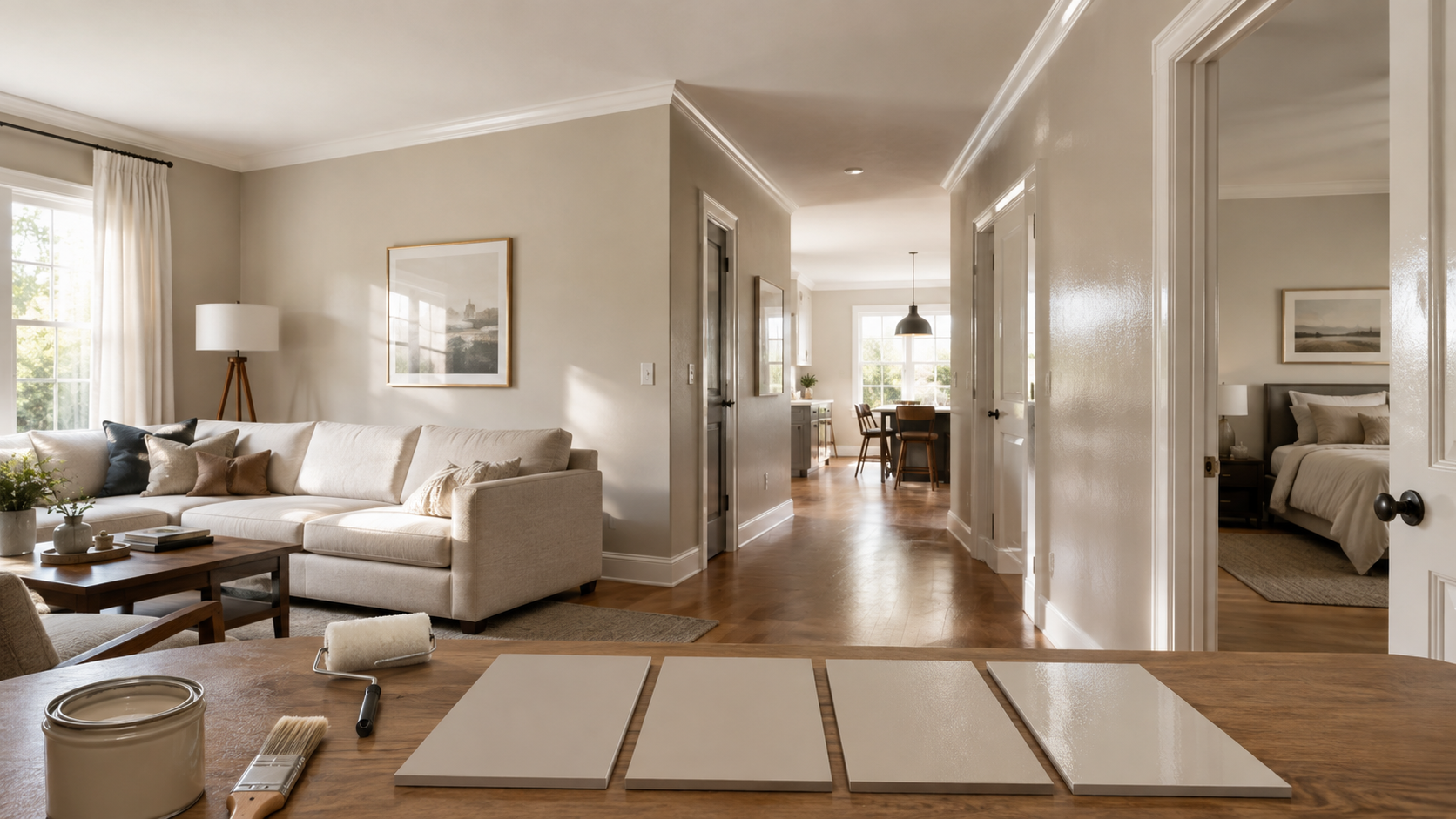
Open-plan homes introduce a unique challenge: the living, dining, and kitchen zones often occupy a common sightline, but homeowners typically choose finishes for each zone independently. The kitchen gets satin because it’s washable, the living room gets flat because it’s inviting, and what you end up with is a noticeable seam right where the two meet, even if the color is the same. Different sheens trap light in different ways, and the eye registers that border whether you realize it or not.
The solution is to decide on one wall finish for any zone that has a continuous vista. If your kitchen calls for satin because of splatters, continue that satin finish into the dining and living area that abuts it rather than dropping back to flat the moment you cross into the next room. You can still switch colors between zones to mark their distinctions, but keep the sheen consistent so the changeover feels intentional rather than haphazard.
This is also where many a good DIY plan comes apart, because it’s harder than you think to maintain identical sheen and color between three or four rooms that blend into each other – matching batch tints, coordinating recoating windows, and keeping your cut lines perfectly straight. When that finish plan encompasses an entire house, most homeowners in the area will just hand the problem over to Interior Painting Services Perth rather than get two rooms in and realize their home reads as two different finishes.
Test finish and color together, not separately
Here’s a fact that even the most vigilant prepsters tend to overlook: the exact same paint color can and will read significantly different based on what finish it’s poured into. A perfect pale gray confirmed in flat may turn even flatter – and more sterile-seeming – if mixed into eggshell or satin, where the higher light-reflecting quality will slightly boost both luminance and chroma. If you’ve selected your hue from a flat chip and then rolled it in satin throughout your walls, prepare to be taken aback when it registers brighter than you expected.
Always test large sample patches, at least a square metre, in the actual finish you plan to use, and view them at different times of day. Morning light, midday light, and evening artificial light all change how a sheen behaves, and light reflectance value matters more as sheen goes up. Skipping this step is one of the most common regrets homeowners report after a repaint.
Budget for what higher sheen actually demands
Glossier paint actually costs more per area, and it requires a more flawless surface below it. When light-reflecting satin and semi-gloss hit a wall with lots of imperfections, low flat paint would have artfully obscured, you end up with no place to hide. Textured walls or too many touch-up layers in an older home reveal their real age and history. To get a shiny topcoat to look right, you first have to properly repair, mud, sand, and prime any problem areas and that’s a surprisingly costly slow-down compared to just rolling on another coat of low-lustre paint.
Paint choice affects more than how we experience a space day to day. The widely cited Zillow 2022 analysis of over 4.6 million home sales found that specific paint decisions moved final sale price – a dark navy bathroom sold for $5,440 more than expected, while mismatched or poorly planned schemes dragged perceived value down. Getting the finish plan right isn’t just about wiping walls clean; it has a real effect on how a home is valued.
Why sequencing across the whole home matters
When each room is treated as a separate project, homeowners might notice visible seams, inconsistent sheen at doorways, and trim that doesn’t match between hallways. A professional painter can work on multiple rooms at a time and let the paint cure properly, ensure precise cut lines on wall finishes, and make sure that the paint’s sheen in different rooms perfectly matches.
Make sure the priority is first set on durability, then ceilings, trim, and finally sightlines. If done correctly, each room in the house will complement the one next to it rather than them standing apart.